Where foreigners live in Korea — and dormitory rules
Verified firsthand · Read the KOSIS tables DT_2FA009F, DT_2FA004F and DT_2FF011F (Statistics Korea, 2025) and the dormitory articles 98, 99, 100 and 100-2 of the Labour Standards Act on law.go.kr on 2026-08-28
Where you sleep in Korea turns out to be closely tied to what you do for a living — and if your employer houses you, four articles of the Labour Standards Act apply to that building whether anyone mentions them or not.
The short answer
Foreign residents aged 15+       1,692,000
Living in a company dormitory    223,000 — 13.2%
In premises not built to live in 73,000 — 4.3%
Living alone                     476,000 — 28.1%
Average household                2.5 people
In the Seoul metropolitan area   972,000 — 57.5%
What kind of home
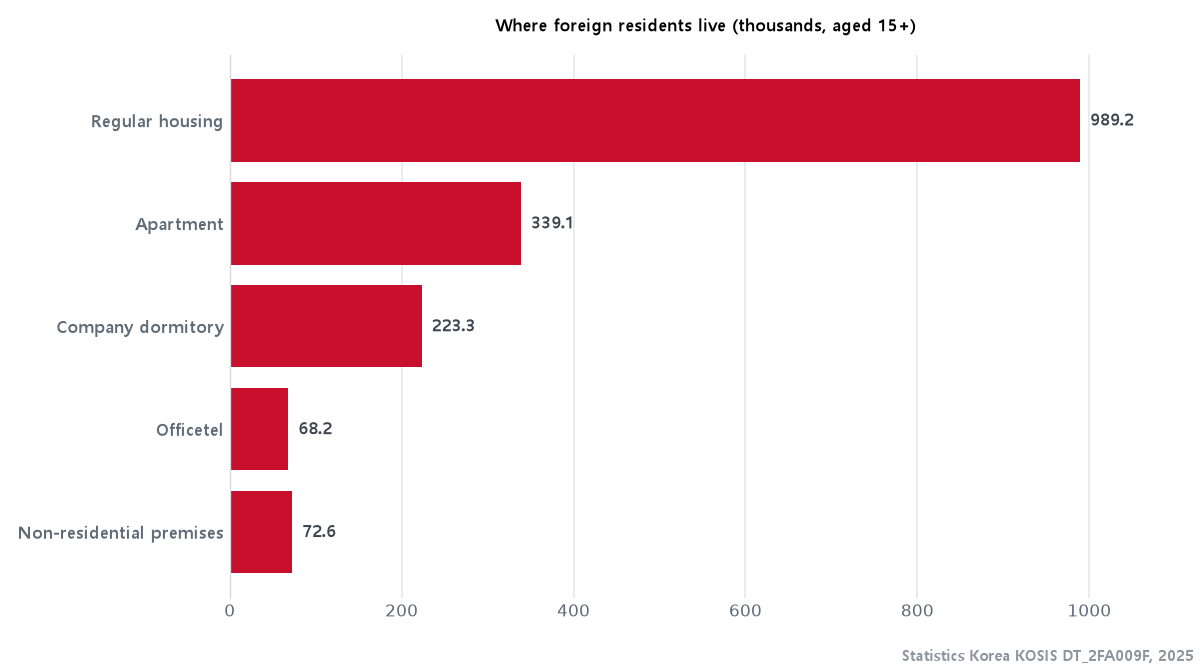
Most people live in ordinary housing. What stands out is the bottom of the chart: 73,000 people live in premises the survey classes as not residential — the category that covers converted containers, greenhouses, factory annexes and similar arrangements.
The employment rates attached to each type say more than the counts do:
| Company dormitory | 87.7% employed |
| Non-residential premises | 87.1% employed |
| Regular housing | 61.3% employed |
| Apartment | 59.7% employed |
| Officetel | 60.7% employed |
Dormitories and non-residential premises are where people who came here to work live. Apartments and officetels hold more students and family members. Housing type is not a lifestyle choice in these numbers; it is a proxy for why you came.
A company dormitory is regulated
If your employer provides the place you sleep, it is a 부속 기숙사 — an attached dormitory — and the Labour Standards Act sets rules for it. These are not guidelines. Two of them carry penalties.
Article 98 (guaranteeing dormitory life):
① An employer shall not infringe on the privacy of the private life of workers residing in an attached dormitory of the business. ② An employer shall not interfere in the election of officers necessary for self-governance of dormitory life.
Article 99 (drawing up and changing rules) requires the employer to write dormitory rules covering six subjects:
| 1 | rising, bedtime, going out and staying out |
| 2 | events |
| 3 | meals |
| 4 | safety and health |
| 5 | management of buildings and facilities |
| 6 | other matters applying to all resident workers |
Clause 2 is the one worth remembering: changing those rules requires the consent of a representative of the majority of the workers living there. A curfew or a visitor ban introduced by notice alone has skipped a step the statute requires.
Article 100 requires the dormitory to meet standards set by Presidential Decree on its structure and facilities, its location, the living environment, its floor area, and other matters needed for safe and comfortable housing. Article 100-2 adds a continuing duty to maintain it for workers' health and privacy.
We have not read the Presidential Decree itself, so we do not quote the specific floor-area or occupancy figures it sets. Ask 1350 for those.
The penalties
| Article 114 | violating Article 100 — fine of up to 5 million won |
| Article 116(2)2 | violating Article 98(2) or Article 99 — administrative fine of up to 5 million won |
A dormitory that fails the Decree's standards is a criminal fine matter, not a complaint-box matter. That is worth knowing before you decide the state of the building is simply how things are.
What can be taken out of your pay for it
Housing provided by an employer interacts with the minimum wage, and the rule runs in the worker's favour:
| Provided in kind (a room, not money) | never counts toward the minimum wage |
| Paid in money (a housing allowance) | only the part above 7% of the monthly converted minimum wage counts |
So an employer who says "your package includes accommodation, so you are comfortably above the minimum" is only partly right — the room itself is excluded from the calculation entirely. Take the accommodation out first, then compare. The full rule is in Korea's minimum wage, and what actually reaches your account is in your payslip.
Note the distinction that catches people out: being charged for the room is a separate question from whether the room counts toward the minimum wage. A deduction from your pay needs its own legal basis, and unexplained deductions belong in the wage-arrears conversation.
Where in the country
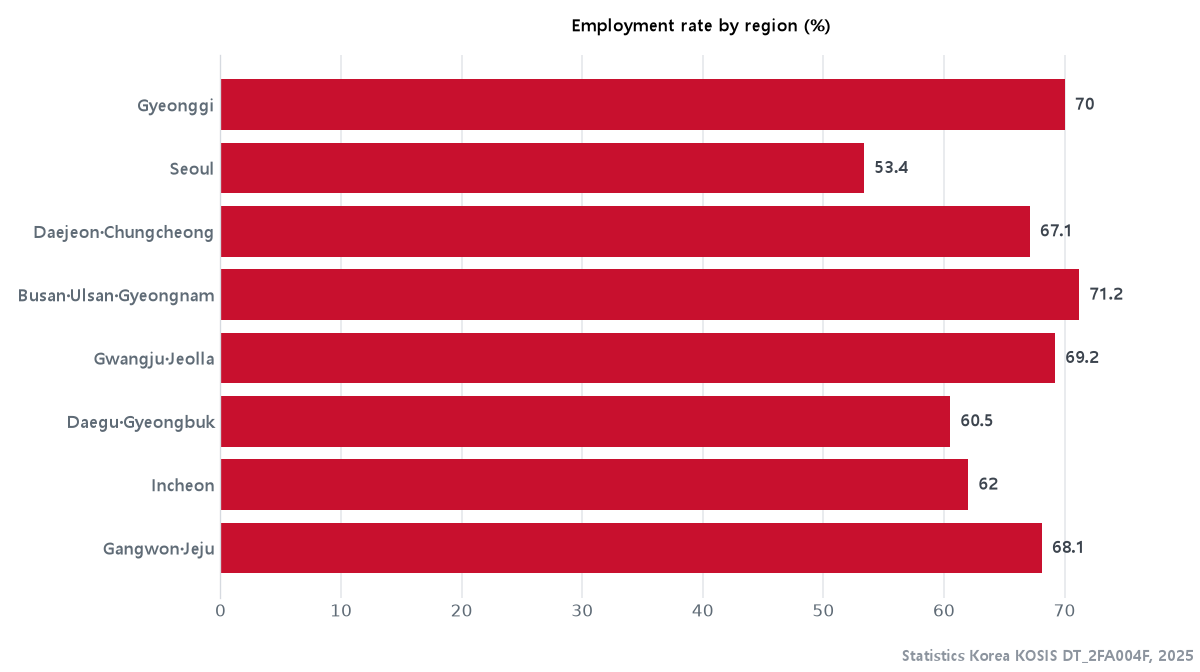
Seoul holds 297,000 foreign residents but has the lowest employment rate in the country at 53.4% — the city concentrates students and family members. Gyeonggi, next door, holds 572,000 and reaches 70.0%. Busan·Ulsan·Gyeongnam leads at 71.2%.
The pattern is industrial. Employment runs high where manufacturing and agriculture are, and lower in the capital where study and family residence are. If you are looking for work rather than a course, the map argues against assuming Seoul is where the jobs are.
Living alone, or not
476,000 foreign residents — 28.1% — live alone, and the average household is 2.5 people. Two-person households are the largest single group at 503,000.
That number matters for a practical reason: a one-person household signs a lease alone, which makes the deposit rules the single largest financial risk most foreign residents carry — see protecting your rental deposit.
What these numbers do not tell you
| Type, not quality | the survey records what kind of building, not its condition |
| Not by visa | housing type is not broken down by residence status |
| 2025 data | published by Statistics Korea; the next release updates it |
| Rounded | counts are in thousands |
| Decree not read | Article 100's specific standards live in a Presidential Decree we have not read — we do not quote figures from it |
Questions people ask
My employer deducts dormitory rent from my wages. Is that allowed? Charging for accommodation and counting it toward the minimum wage are two different questions. A room provided in kind never counts toward the minimum wage. Whether a specific deduction is lawful depends on its basis — take your payslip and contract to 1350.
The dormitory has a curfew nobody agreed to. Article 99(2) requires the consent of a representative of the majority of resident workers to make or change dormitory rules, and Article 98(1) protects privacy of private life. Both are worth raising.
The building is not really fit to live in. Article 100 requires standards set by Presidential Decree, and Article 114 makes a violation punishable by a fine of up to 5 million won. Labour inspectors have the power to inspect dormitories.
Where do I ask? Ministry of Employment and Labour 1350, with interpretation.
Sources
Statistics Korea, KOSIS — 2025 figures, foreigners only
   DT_2FA009F  Economically active population by type of housing (immigrants)
   DT_2FA004F  Economically active population by region (immigrants)
   DT_2FF011F  Household size and type (immigrants)
   https://kosis.kr

Labour Standards Act
   [in force 2026. 8. 20.] [Act No. 21373, amended 2026. 2. 19.]
   Article 98 (guarantee of dormitory life)
   Article 99 (drawing up and changing rules)
   Article 100 (standards for installing and running an attached dormitory)
   Article 100-2 (duty to maintain) · Article 114 · Article 116(2)2
   https://www.law.go.kr/법령/근로기준법

Minimum Wage Act Article 6(4)3 — accommodation in kind and in money

Ministry of Employment and Labour: 1350 (interpretation available)