What foreign workers in Korea earn
Verified firsthand · Read the raw KOSIS tables DT_2FC001F and DT_2FB008F (Statistics Korea, 2025 figures released 2025-12-04) and computed every share here from the published counts on 2026-08-28
"How much do foreigners make in Korea" is one of the most searched questions about working here, and almost every answer you find is somebody's guess.
There is no need to guess. Statistics Korea surveys foreign residents every year and publishes the results by visa type. Below is what the 2025 survey actually says.
The short answer
| Foreign wage earners surveyed | 1,047,000 |
| Earning 2 million won or more | 87.1% of them |
| On an E-9 visa | 99.5% earn 2 million won or more |
| On a student visa (D-2, D-4) | only 12.6% do |
| Average hours worked | 42.9 per week, and falling |
| Survey | Statistics Korea, 2025 figures |
What each visa earns
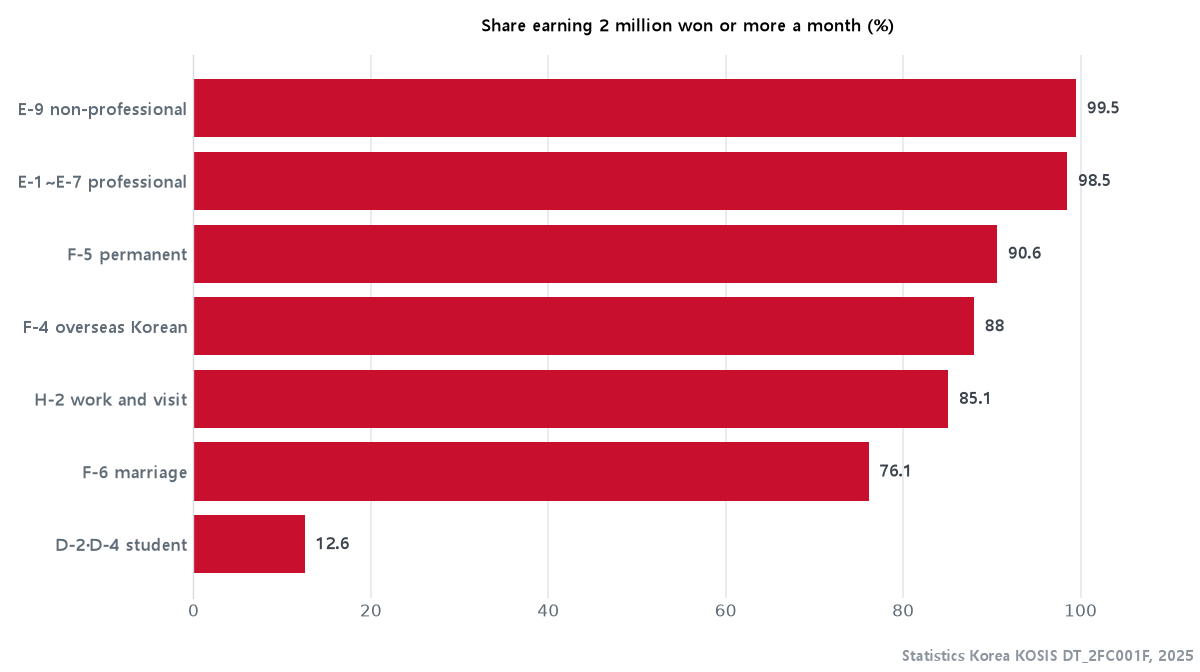
The ordering surprises people. E-9 — the "non-professional" visa — sits at the top, above the professional E-1~E-7 group, at 99.5%.
That is not because E-9 pays better. It is because E-9 is full-time by design. The visa ties you to one workplace on a full-time contract, so almost nobody on it works the short hours that pull a wage under 2 million won. The professional visas include part-time lecturers and researchers; the student visas are capped by law at part-time hours.
Read the chart as "who works full time" at least as much as "who is paid well".
The full distribution
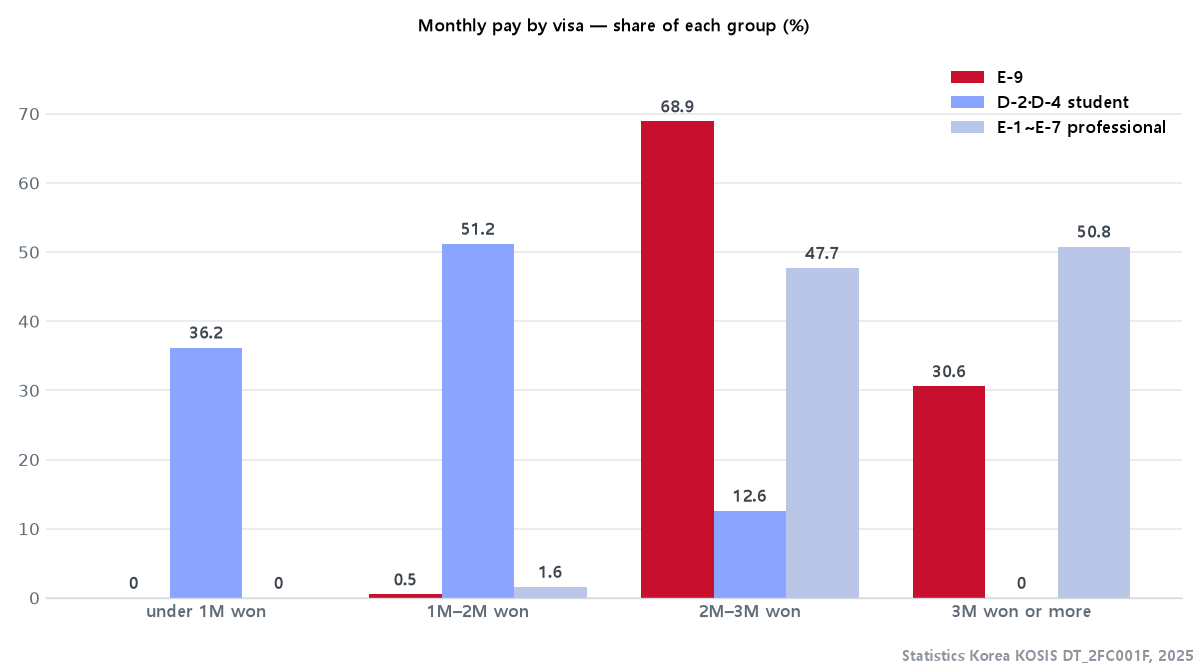
Three groups, three completely different shapes:
| E-9 non-professional | 68.9% earn 2–3 million · 30.6% earn 3 million or more under 1 million rounds to zero in the published figures |
| E-1~E-7 professional | 50.8% earn 3 million or more — the highest share of any group |
| D-2·D-4 student | 36.2% under 1 million · 51.2% between 1 and 2 million |
The student figure is not a wage problem, it is an hours limit. A study visa allows part-time work only, within a weekly cap — see which visas allow you to work.
The E-9 shape is the interesting one. Nearly a third of E-9 workers clear 3 million won a month. That is well above what minimum-wage hours alone produce, which tells you overtime and night work are doing a lot of the lifting — and that makes how overtime is calculated the single most valuable thing an E-9 worker can learn to check.
A yardstick for the bands
The survey reports bands, not an average, so here is a reference point you can compute yourself. Korea's 2026 minimum wage is 10,320 won an hour. A standard full-time month is usually counted as about 209 hours — 40 contracted hours plus the weekly paid rest day, averaged over a year:
| (40 + 8) hours × 52.14 weeks ÷ 12 months | ≈ | 209 hours |
| 209 × 10,320 won | ≈ | 2,157,000 won before deductions |
So the 2–3 million band is roughly "minimum wage full time, up to about half again on top". If you are in that band and working long hours, the question is whether the extra hours were paid at the legal premium. If you are below it while working full time, something is wrong — start with Korea's minimum wage rules.
Note the timing mismatch: the survey is 2025 data and 10,320 won is the 2026 rate. Use it as a yardstick, not as a comparison.
How long people actually work
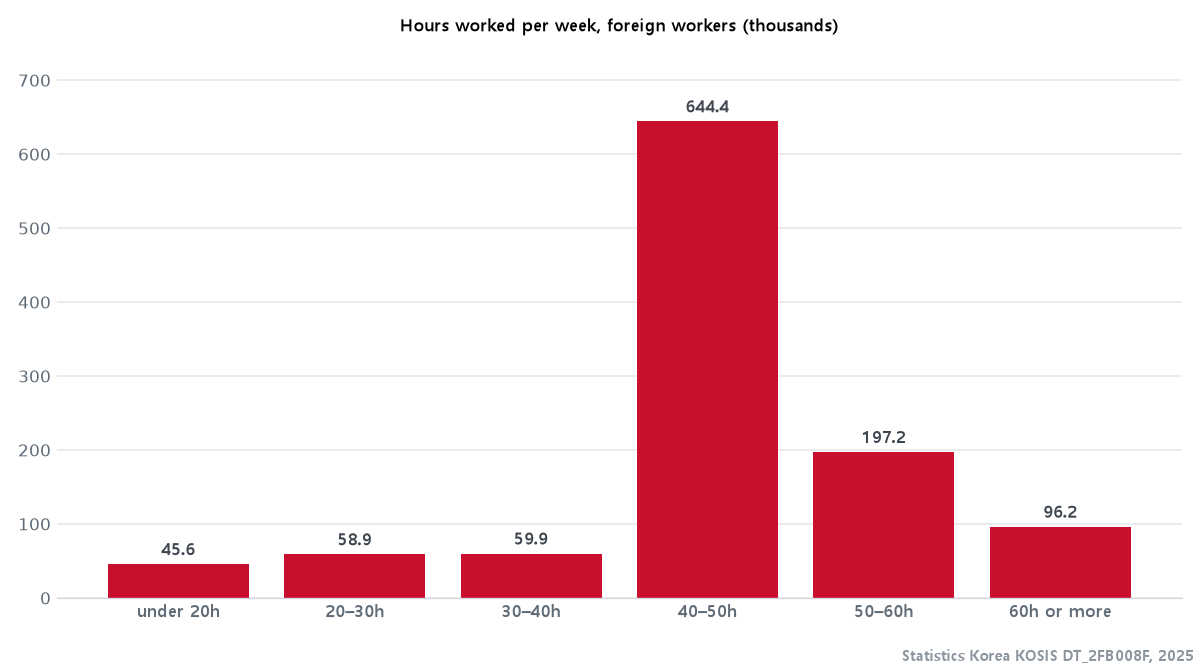
Average weekly hours have fallen three years running — 43.6 → 43.2 → 42.9.
But the average hides the tail. Of 1,109,000 foreign workers in employment, 293,000 — 26.4% — work 50 hours or more a week, and 96,000 work 60 hours or more.
That matters legally, not just physically. The statutory ceiling is 40 hours a week plus a maximum of 12 hours of agreed overtime, so anything past 52 hours is over the line no matter what anyone signed. The 60-hour group is, on its face, outside what the Labour Standards Act permits.
(One caution on the denominators: the pay figures count 1,047,000 wage earners, while the hours figures count 1,109,000 people in employment, which includes the self-employed. They are not the same population, so do not divide one by the other.)
What these numbers do not tell you
Being straight about the limits is part of using them well:
| Not an average | the survey publishes bands, not a mean wage. Anyone quoting "the average foreign worker earns X" is not getting it from this table |
| Before deductions | these are gross figures — see what comes off in your payslip |
| Not by nationality | the wage table splits by visa and sex, not by country |
| 2025 data | published 2025-12-04; the next release updates it |
| Rounded | counts are in thousands, so small cells show as 0.0 — that means "rounds to zero", not "nobody" |
Every percentage on this page was computed from those published counts. The bands are official; the arithmetic is ours.
Check your own number
Statistics tell you where you sit. They do not tell you whether you were paid correctly. Those are different questions, and the second one is the one worth your evening:
- Korea's minimum wage — what actually counts toward it
- Working hours and overtime — the 50% and 100% premiums
- Your payslip and unpaid wages — reading the deductions
- Annual paid leave — the weekly paid rest day is part of your pay
Questions people ask
Is E-9 really better paid than a professional visa? No. E-9 has the highest share above 2 million won because it is full-time by design. At the top of the scale the professional visas lead clearly — 50.8% above 3 million won, against 30.6% for E-9.
Why do students earn so little? Their visa restricts them to limited part-time hours. It is an hours cap, not a pay rate.
What is the average monthly wage for a foreigner in Korea? This survey does not publish one. It publishes the distribution, which is what the charts above show. Anyone quoting a single average number for foreign workers is not quoting this table.
Where can I ask about my own pay? The Ministry of Employment and Labour on 1350 has interpreters. Bring your payslip and your contract.
Sources
Statistics Korea, KOSIS
   DT_2FC001F  Wage earners by monthly wage level (immigrants), 2025
               foreigners only, excluding naturalised citizens
   DT_2FB008F  Employed persons by hours worked (immigrants), 2025
   https://kosis.kr

Minimum Wage Act — 2026 hourly minimum 10,320 won
   Minimum Wage Commission announcement

Ministry of Employment and Labour: 1350 (interpretation available)