Who changes visa, who learns Korean
Verified firsthand · Read the KOSIS tables DT_2FK005R, DT_2FQ003R, DT_2FK004R and DT_2FF001F (Statistics Korea, 2025) on 2026-08-28 and quote the published percentages without adjustment
Three separate questions in the government's survey turn out to have the same answer. How many people changed their visa, how long they studied Korean, and whether they left the country at all last year — line the three up by residence status and the same group is at the bottom of all three.
The short answer
| Changed residence status at least once | 43.8% of all foreign residents |
| Among E-9 holders | 0.1% |
| Among F-5 permanent residents | 99.3% — half of them twice or more |
| Average time studying Korean | 20.7 months overall · 8.9 for E-9 |
| Left Korea at any point last year | 20.1% overall · 11.5% for E-9 |
Who changes status
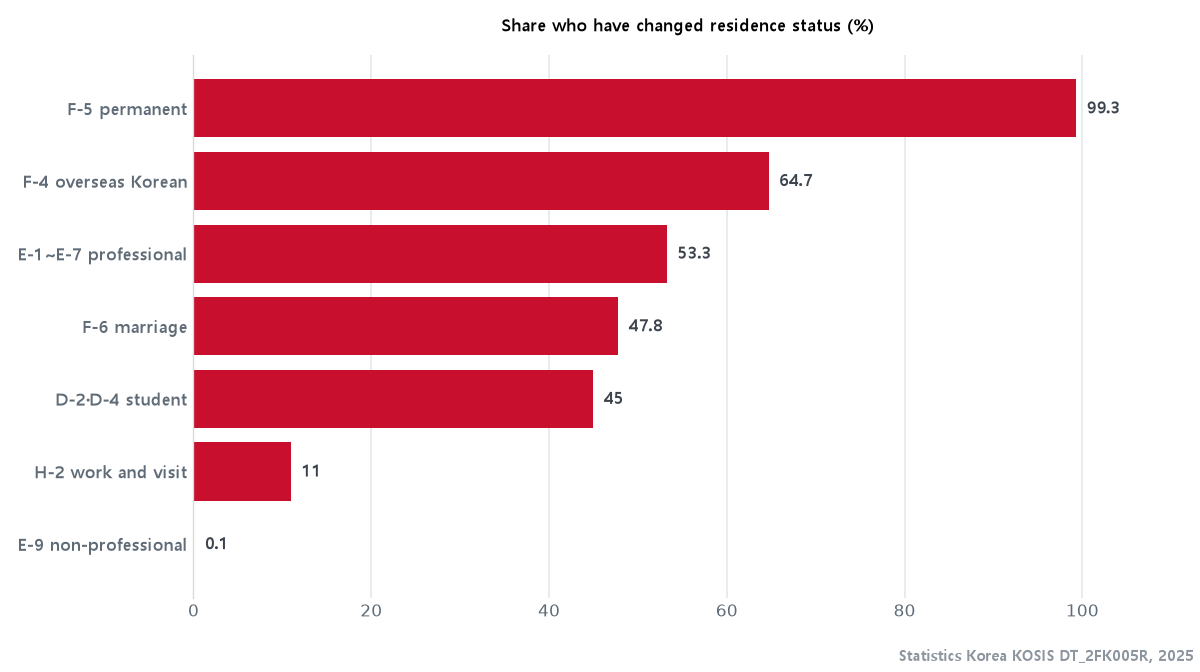
Nearly everyone holding permanent residence got there by changing status — 99.3%, and 51.8% changed twice or more. That is what a settlement path looks like from the far end: F-5 is a destination, not an entry visa.
At the other end, E-9 is 0.1%. Not low — essentially zero. Of the 320,900 people in Korea on a non-professional employment visa, the survey finds almost nobody who has moved to a different status.
In between, the numbers describe how open each route is:
| F-5 permanent | 99.3% | |
| F-4 overseas Korean | 64.7% | |
| E-1~E-7 professional | 53.3% | |
| F-6 marriage | 47.8% | |
| D-2·D-4 student | 45.0% | |
| H-2 work and visit | 11.0% | |
| E-9 non-professional | 0.1% | |
45% of students have already changed status once — the study-to-work transition is a real, well-travelled route. For E-9 it is not.
That does not mean no path exists on paper. It means that as of the 2025 survey, the people currently holding E-9 had almost all not taken one. If you are on E-9 and planning ahead, plan on the assumption that this is difficult, and note that changing workplace is a different question with its own rules — changing workplace on an E-9 visa.
How long people study Korean
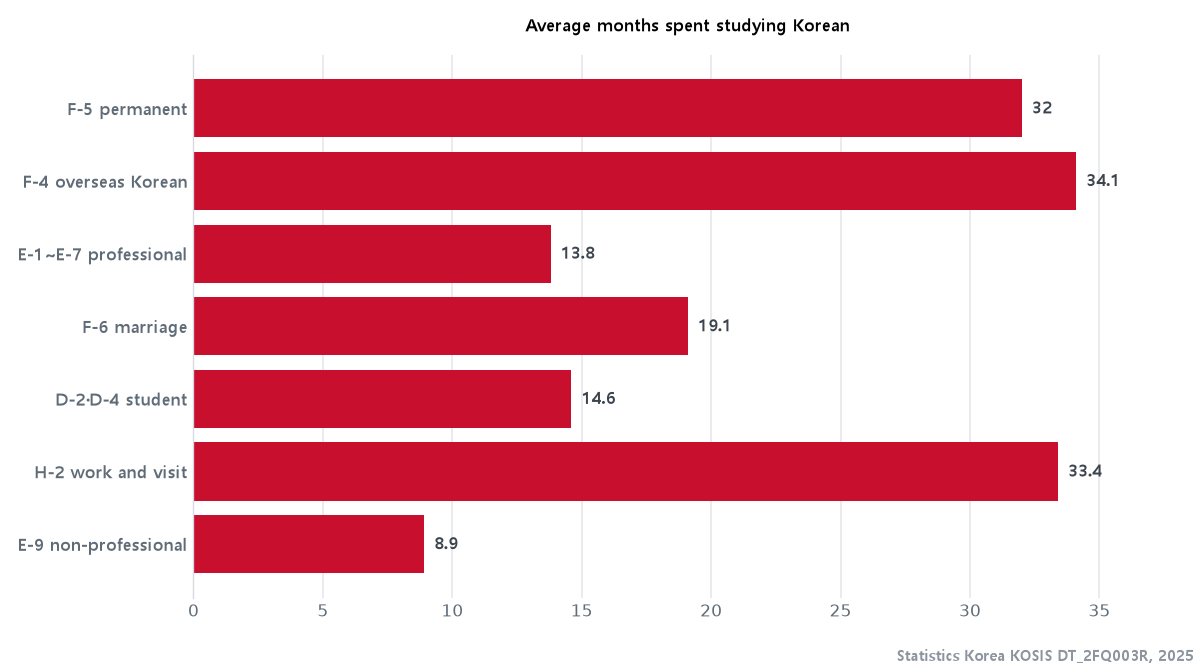
The average across all foreign residents is 20.7 months. By status:
| F-4 overseas Korean | 34.1 months | 82.4% studied 36 months or more | |
| H-2 work and visit | 33.4 months | 84.4% studied 36 months or more | |
| F-5 permanent | 32.0 months | 74.7% studied 36 months or more | |
| F-6 marriage | 19.1 months | ||
| D-2·D-4 student | 14.6 months | ||
| E-1~E-7 professional | 13.8 months | ||
| E-9 non-professional | 8.9 months | 4.7% studied 36 months or more | |
E-9 is again last, at roughly a quarter of the top figure, and only 4.7% of E-9 holders have studied Korean for three years or more.
Be careful about the direction of that arrow. The groups at the top are largely people of Korean descent or long-settled residents — for many of them the language came with the family, and the long "study period" reflects a life here rather than a course of lessons. The E-9 figure reflects something more concrete: a visa with a fixed term, long hours, and little time or reason for a language course. Note also that the two H-2 and F-4 groups are the ones who could most easily have learned Korean before arriving.
The practical point for anyone on a work visa is unchanged: language is the thing that turns a workplace problem into a solvable one. When it has not turned, 1350 provides interpretation, which is why that number appears at the bottom of every article we write.
Who leaves the country
Asked whether they had stayed outside Korea at any point in the past year:
| All foreign residents | 20.1% yes | |
| H-2 work and visit | 26.6% | |
| F-5 permanent | 25.1% | |
| F-6 marriage | 24.0% | |
| F-4 overseas Korean | 22.3% | |
| D-2·D-4 student | 19.1% | |
| E-1~E-7 professional | 17.8% | |
| E-9 non-professional | 11.5% | ← lowest |
Most of those trips were short: 12.0% of all residents were away for less than a month. E-9 holders are the least likely to have gone anywhere — 11.5%, roughly half the rate of the settled groups.
Three tables, three subjects, and the same group at the bottom of each. Whatever else the statistics describe, they describe a status whose holders stay put, stay in place, and stay on the same visa.
A fourth table, the same shape
One more table asks a different question and gives the same answer. Of foreign-national spouses living in Korea — 428,200 of them — here is the status each spouse holds:
| F-4 overseas Korean | 178,300 | ||
| Other | 96,100 | ||
| F-5 permanent | 81,800 | ||
| H-2 work and visit | 24,300 | ||
| E-1~E-7 professional | 15,600 | ||
| E-9 non-professional | 15,000 | ||
| F-6 marriage | 9,400 | ||
| D-2·D-4 student | 7,600 | ||
F-4 and F-5 together account for 60.7% of them. The settled statuses are where a spouse is also here; the fixed-term work statuses are where they are not.
One caution on reading this: the table counts spouses, not people with a spouse. It does not tell you what share of E-9 holders have their partner in Korea, and dividing one table by another would give a wrong answer. What it does show is the shape — families live together on settlement statuses.
The split by sex is nearly even: 223,900 men and 204,300 women.
How large is each group
For scale, foreign residents aged 15 and over by status:
| F-4 overseas Korean | 409,800 | ← the largest group | |
| E-9 non-professional | 320,900 | ||
| D-2·D-4 student | 236,200 | ||
| F-5 permanent | 162,700 | ||
| F-6 marriage | 127,800 | ||
| E-1~E-7 professional | 82,100 | ||
| H-2 work and visit | 73,000 | ||
F-4 being the largest group surprises most people, who assume E-9 dominates.
What these numbers do not tell you
| A snapshot, not a path | "has changed status" describes people holding a status today, not the chance of changing it in future |
| Not the legal rules | the survey does not say which changes are permitted; that is immigration law, not statistics |
| Self-reported | study time and travel are answers people gave, not administrative records |
| 2025 data | published by Statistics Korea |
| Foreigners only | naturalised citizens are excluded here |
Read next
- Changing workplace on an E-9 visa — the count and the deadline
- Which visas allow you to work — status decides the rest
- Your alien registration card — the document behind the status
- Who actually works in Korea — the same split, by employment rate
Questions people ask
Can I change from E-9 to another visa? This survey cannot answer that — it counts people, not rules. What it shows is that 99.9% of current E-9 holders have not. For the rules, ask Immigration on 1345.
Does studying Korean help me change status? The survey does not link the two. What it shows is that the groups with the longest study time are the settled ones, which is at least as likely to be an effect as a cause.
Which number should I trust for my own plan? None of them, on their own. Statistics describe a population; your case is decided by your status, your employer and your dates.
Sources
Statistics Korea, KOSIS — 2025 figures, foreigners only
   DT_2FK005R  Change of residence status and number of changes (immigrants)
   DT_2FQ003R  Period of studying Korean (immigrants)
   DT_2FK004R  Stays outside Korea in the past year (immigrants)
   DT_2FF001F  Resident population aged 15 and over (immigrants)
   DT_2FF010F  Residence status of foreign-national spouses living in Korea
   https://kosis.kr

Immigration Contact Centre: 1345
Ministry of Employment and Labour: 1350